

Internet outage on a Saturday afternoon? For many stores, it’s a nightmare scenario that means chaos and lost profits. Find out how a modern POS system with offline mode turns a paralyzing problem into a barely noticeable inconvenience, ensuring sales continuity and your peace of mind.
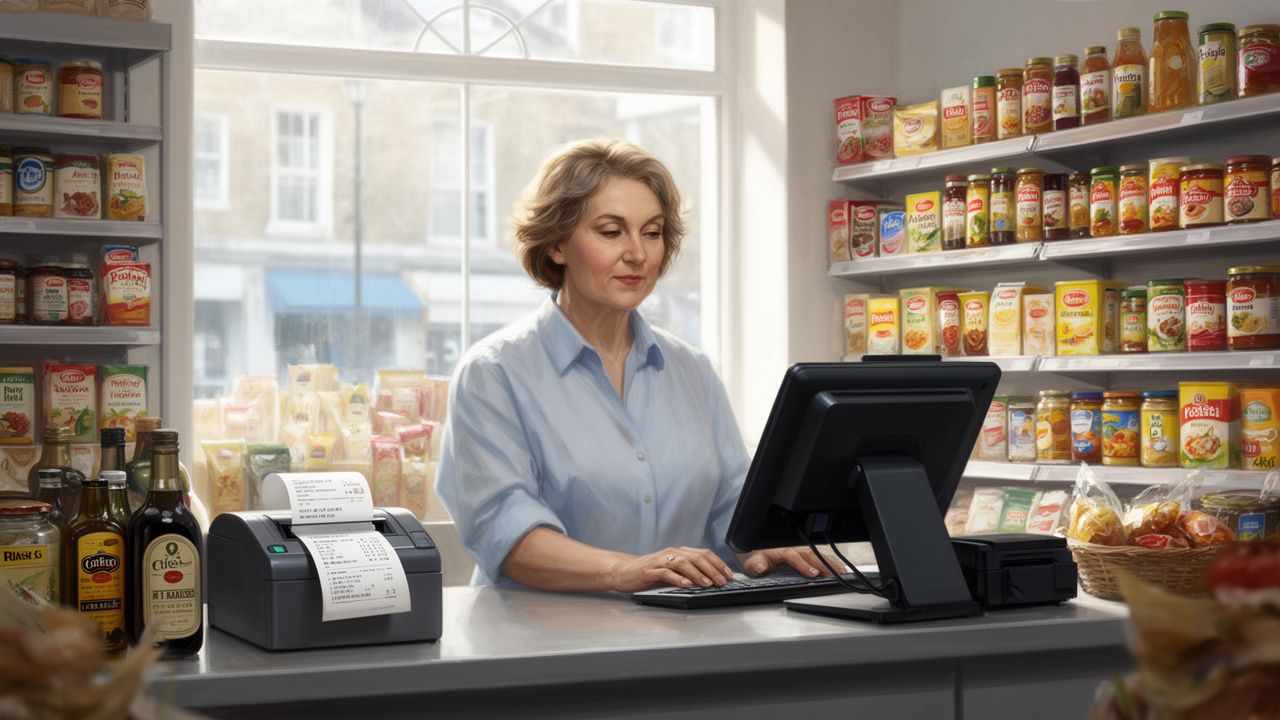
Offline mode is a feature of a modern point of sale (POS) system that allows key sales operations to continue even without an active internet connection. In practice, this means that your employee can still scan products, finalize transactions, and print receipts, while customers do not experience any interruptions in service. All sales data, such as sold goods, transaction amounts, and changes in inventory levels, are temporarily stored in the secure memory of the local device – your cash register.
As soon as the internet connection is restored, the system automatically begins to synchronize. The locally stored data is sent to the central cloud database, updating reports, inventory levels, and any other information visible in the management panel (back-office). From a manager’s perspective, after synchronization is complete, there are no gaps in the system – all transactions from the offline period are in their place, as if the outage never happened. This is a fundamental difference compared to older cash registers or simple applications that become practically useless without network access.
This is one of the most important questions that affects the financial liquidity of the store during an outage. The answer is: yes, but with certain conditions you need to be aware of. Most modern payment terminals (provided by companies like SumUp, Zettle, Worldpay, or Elavon) have a feature called “Store and Forward”. This allows for accepting contactless payments and chip cards when the terminal has no internet connection.
The transaction is temporarily authorized, and its data is securely stored in the terminal’s memory. Once connectivity is regained, the terminal automatically sends the collected transactions for processing. However, there are two key limitations to keep in mind. First, there is a limit on the value of a single transaction accepted in offline mode (often around £100). Second, payment service providers impose a time or quantity limit on such transactions (e.g., 24 hours or a specified total amount). This is a safeguard against the risk that after processing the transaction online, it may be declined (e.g., due to insufficient funds in the customer’s account). Always check the offline mode terms with your terminal provider to know the exact limits and rules.
This is a common myth that often stems from experiences with unstable, amateur solutions or outdated software. Modern, professional POS systems are designed specifically with such scenarios in mind. Sales data in offline mode is not stored in volatile memory but in a permanent, secured space on the cash device’s disk. The risk of losing them due to offline mode itself is virtually zero.
The facts are that the only real threat to the data is physical damage to the device itself (e.g., hard drive destruction) while it was operating in offline mode. However, this is an extremely rare situation. POS systems have built-in verification and automatic synchronization mechanisms that ensure that no transaction is missed. Once the connection is restored, the system “talks” to the server, filling in all missing information. The owner of the store “Polskie Delikatesy” in Leeds learned this when construction work on the street damaged the fiber optic cable for almost an entire day. Thanks to offline mode, his store continuously served customers, and all sales data worth over £4000 were fully synchronized the next morning, without losing a single pound.
Although the key function – sales – remains intact, it is important to know what temporarily stops working. Awareness of these limitations allows for better management of the situation. In offline mode, functions that require real-time communication with the central server are typically unavailable. These include:
Theoretically, most POS systems can store sales data for many days or even weeks. The capacity of local memory is rarely an issue. The real limitation is the aforementioned functionality of the payment terminal. It is the limits imposed by the payment service provider (e.g., maximum cumulative amount of offline transactions or a time limit of 24-48 hours) that dictate how long you can safely accept card payments without the internet.
Therefore, offline mode should be treated as a reliable safety net for short and medium outages (from a few minutes to several hours), not as a permanent way of working. The main goal should always be to quickly diagnose the problem and restore the internet connection. Regardless of technical capabilities, the shorter the store operates offline, the lower the risk of any complications.
Preparation is key to peace of mind. Instead of reacting in panic, it’s better to have a simple action plan in place. First, invest in a professional POS system for which offline mode is a standard, well-developed feature, not just a marketing slogan. Second, train the staff. Every employee should know what the lack of connection message means, how to check if the register has switched to offline mode, and what the potential limitations are for accepting card payments. A brief, simple instruction will suffice.
Finally, consider a fail-safe solution that practically eliminates the problem – a backup internet connection. A small 4G/5G router with a SIM card is now an expense of several dozen pounds and a small monthly subscription. Many modern routers can automatically switch to the cellular network as soon as they detect an outage of the main connection (DSL or fiber). This is an investment that ensures nearly one hundred percent continuity of operation and completely eliminates the stress associated with internet outages.
The coming months will see increased traffic in retail. Make sure your POS system and store procedures are ready for any challenge – including unexpected internet outages. It’s an investment in peace of mind that is priceless.