

Is your store losing customers after closing hours? Discover how a store in Sheffield, through a 24-hour pickup kiosk, not only increased sales but also debunked the 5 biggest myths about automation in retail. See the real results after 6 months.
Many owners of Polish stores in the UK face the same dilemma: how to compete with supermarkets that are open late while maintaining a healthy boundary between work and personal life. Extending opening hours means higher staff and utility costs without guaranteeing a proportional increase in profits. Meanwhile, a store in Sheffield has embraced technology by implementing an external, 24/7 online order pickup kiosk – and after six months, it shares insights that could change your perspective on the future of retail.
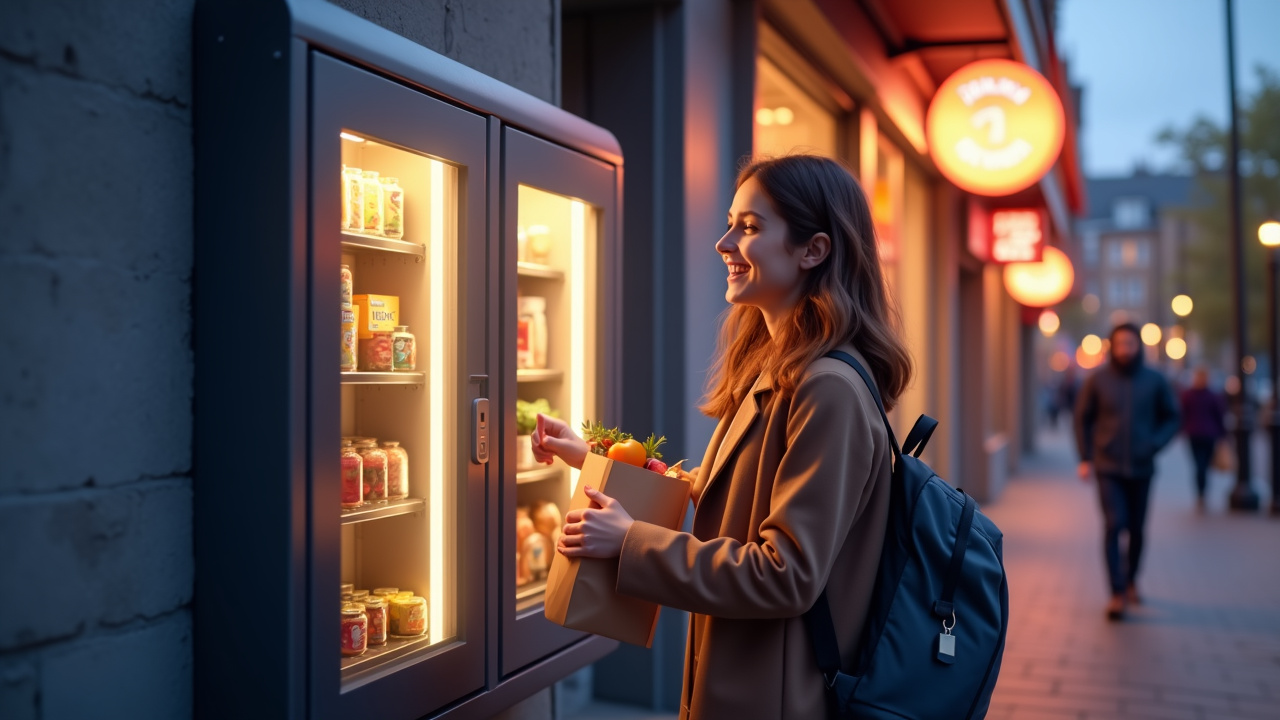
The idea is simple, but its potential is enormous. A pickup kiosk (also known as a parcel locker or automated package locker) is a set of lockable, secure compartments integrated with your store’s e-commerce system. The process for the customer and staff is maximally simplified and boils down to a few steps. The customer places an order on your online store and selects “24/7 Pickup” as the delivery option.
Then, at a convenient time – for example, during off-peak hours – a store employee assembles the order, places it in one of the available compartments, and locks it. The system automatically sends an SMS or email notification to the customer with a unique code. From that moment on, the customer can pick up their purchases at any time of day or night by entering the code on the kiosk’s control panel, which opens the appropriate compartment. This solution frees the sales process from the employees’ schedules and the store’s opening hours.
The store in Sheffield in question is an independent location of about 100 square meters, situated in an area with a large population of Poles, as well as Brits and other nationalities, often working shifts in nearby warehouses and factories. The owner, facing increasing competition from a local Tesco Express, decided to offer something that the giant did not have: ultra-fast pickup of Polish specialties at any time. Investing in a modular kiosk with 16 compartments (including two refrigerated ones) was a bold step that, after six months, allows for drawing hard, business conclusions.
The decision to implement the pickup kiosk was preceded by many doubts. The owner of the store in Sheffield, like many other entrepreneurs, had to face popular myths regarding automation in small retail. Today, enriched by six months of experience, he can confidently debunk each of them.
The belief that advanced technology is reserved for giants with unlimited budgets is long outdated. Today, systems like pickup kiosks are scalable and available in models that do not require million-dollar investments. You can start with a small module with a few dozen compartments, and as the service’s popularity grows, expand it with additional segments. Suppliers offer flexible financing options, including leasing, which significantly lowers the entry threshold. The store in Sheffield is the best proof of this. As an independent, family business, it has proven that innovation is not a matter of size but of vision and courage. The key is to choose a technology partner who understands the specifics of small retail and can tailor the solution to real needs and capabilities, not the other way around.
When talking about costs, one must look at them through the lens of return on investment (ROI). Of course, at the start, capital is needed to purchase or lease the device, its installation, and the integration of software with the online store. However, let’s compare this to the alternative, which is hiring an additional employee to handle the evening shift. The cost of staff, contributions, vacations, and additional utility charges quickly exceeds the monthly leasing payment for the kiosk. In Sheffield, the calculation was simple: the kiosk generates sales for 168 hours a week, while an employee works an average of 40 hours. After six months, the additional turnover generated solely by “after-hours” orders amounted to about £12,000. Analysis showed that the investment, including maintenance costs (electricity, software subscription), is likely to pay off fully within 18 months, and is already generating a net profit. A similar case study from a store in Luton showed that their kiosk, generating an average of 12 additional transactions daily, increased the store’s total turnover by 8% over the year.
This is one of the biggest fears that often paralyze decisions about modernization. The owner of the store in Sheffield also assumed that his customers value direct contact and chatting at the checkout. And he was right – but only partially. He forgot about the growing group of customers for whom convenience and time are paramount. These are shift workers, young parents, busy professionals, or simply people who remember they need bread at 10 PM. Data from Sheffield is clear: in the first month, only 5% of online orders were fulfilled through the kiosk. However, after an intensive information campaign in the store and on social media, after three months, this percentage rose to 20%, and after six months stabilized at 35%. Interestingly, almost half of the orders are picked up between 9 PM and 7 AM, proving that the service has met a real, unmet need.
Security is an absolute priority. Modern pickup kiosks are not simple, metal lockers. They are built from durable steel, resistant to weather conditions and attempts at vandalism. Built-in video monitoring (CCTV) that records continuously is standard. The entire area is usually well-lit, which further deters potential vandals. The access system based on unique, one-time codes is highly secure. During the six months of operation of the kiosk in Sheffield, there has been no recorded incident of vandalism or attempted break-in. The owner admits that his initial concerns were exaggerated. Statistically, the risk of theft of goods from a secured compartment is significantly lower than the risk of shoplifting during opening hours.
On the contrary – automating this process aims to optimize the work of already employed staff. Implementing the pickup kiosk did not create the need for a new position. Only the scope of duties for one of the employees changed. Instead of waiting for customers during less busy times, this employee now spends about 90 minutes a day efficiently assembling all online orders – both those for pickup at the kiosk and those for home delivery. The entire process is simple: the system notifies of a new order, the employee packs it, scans the barcode on the package, and then the code on the locker door. The doors open automatically, the employee places the package inside, closes it, and it’s done. The system takes care of the rest. The owner from Sheffield emphasizes that this allows his team to focus better on customer service in the store during peak hours, which has translated into higher service quality and greater customer satisfaction.
The experiences gathered in Sheffield allow for formulating several universal truths about modern retail:
The example from Sheffield is not a futuristic vision but a real, proven business model that works here and now. Before the next hot sales season arrives, it’s worth analyzing the potential of such a solution in the context of your location, customer base, and strategic goals. This could be a step that not only increases your revenue but also gives you something invaluable – more control over your business and more time for yourself.